
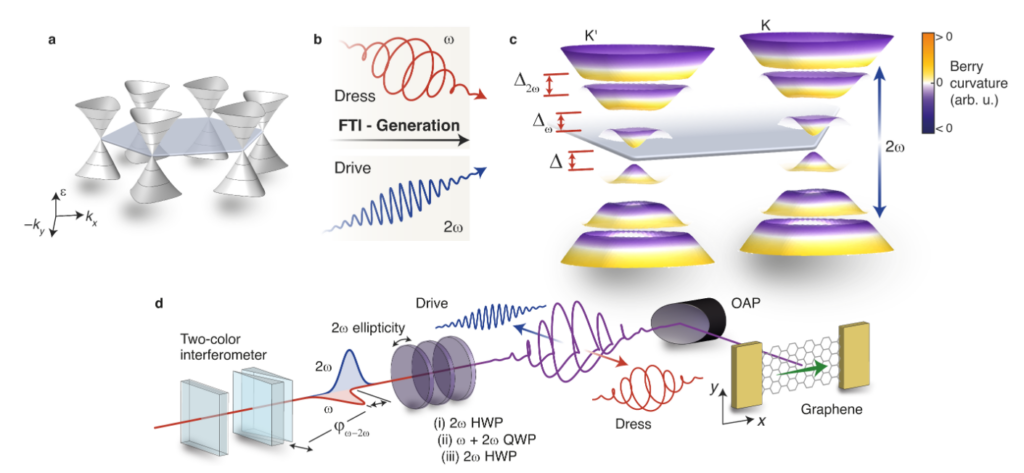
A new paper published in Nature Physics shows that we can turn graphene into a Floquet insulator by focusing circularly polarized light onto it. This fundamentally changes the electrical properties of graphene: the material transforms from a (semi-)metal into an insulator as a band gap opens. What makes this Floquet insulator particularly interesting is that it is also topologically non-trivial. As a result, the electrons can behave in seemingly unusual ways. For example, a Hall voltage develops even in the absence of a magnetic field when we irradiate the light-dressed graphene with additional linearly polarized laser pulses – representing the first demonstration of a purely optical anomalous Hall effect. The original open-access publication is available here.
Ingrid Fadelli recently wrote an interesting commentary on this publication for the Phys.Org website, which also describes how we came to publish this paper in the first place. The commentary can be found here. And here you can find FAU’s press release on our paper.