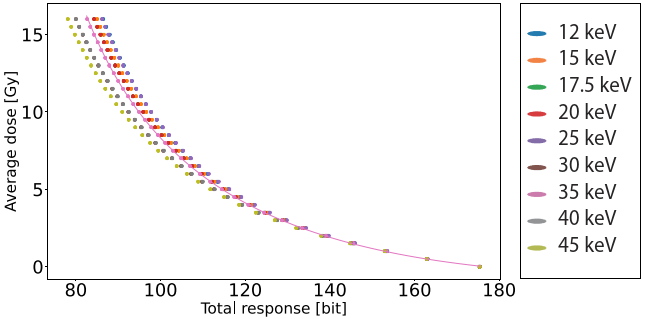
In order to test the vision of an endoscopic device for radiotherapy based on DLA structures, we are currently establishing biophysical experiments with low-energy electron radiation in the 30-50 keV range. In order to investigate the biological effectiveness – a measure of the effectiveness of the radiation – of this low-energy electron radiation and to compare it with previous irradiations such as X-rays, comprehensible dosimetry is required. Due to the low penetration depth of a few micrometres, which is very advantageous for medical applications, commercially available dosimeters cannot be used. Only unlaminated EBT3-GafChromic films, so-called film dosimeters, are suitable in this energy range. The higher the absorbed dose, the darker the films appear.
We describe a possible calibration methode in this publication. Firstly, the dose depth curve was simulated within the active layer of the films. In comparison to high-energy radiation, which has been used in radiotherapy up to now, it drops very quickly and shows a non-linear progression. This dose depth curve is then offset against the measured degree of discolouration compared to calibrated high-energy radiation in such a way that the discolouration determined from a scan can be assigned to an average dose. This final calibration curve is fundamental for the following biophysical experiments.
Dosimetry for low energy electrons in the range of 12–45 keV with EBT3 GafChromic films, published in Physics in Medicine & Biology